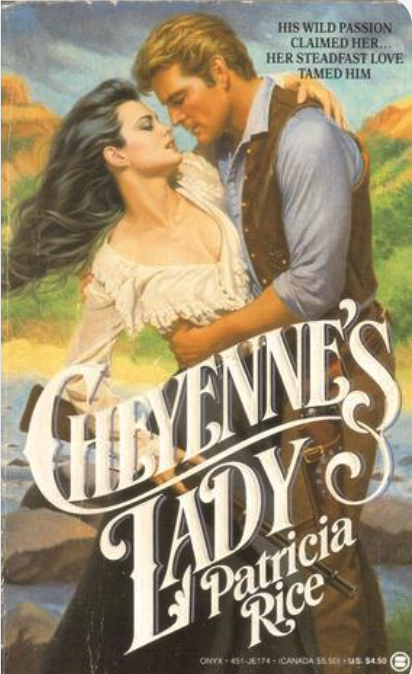
Cheyanne’s Lady
Patricia Rice
The Story
Her heart pounded as his lips closed over hers. Never before had she been kissed like this... never before had she been so willing to surrender to love's passionate promise...
Daughter of New Mexico cattle baron and an enchantingly lovely Mexican aristocrat, Maria Connolly had inherited her father's courage and strength and her mother's pride and beauty. But with both her parents dead, she found herself alone and vulnerable as her person and property came under siege by the local landowner who wanted to possess both. That was when Cheyenne Walker rode into her life, guns glittering on his hips, offering Maria the help and strength she so desperately needed and the passionate embraces she so hungrily desired.
Detail Worth Noticing
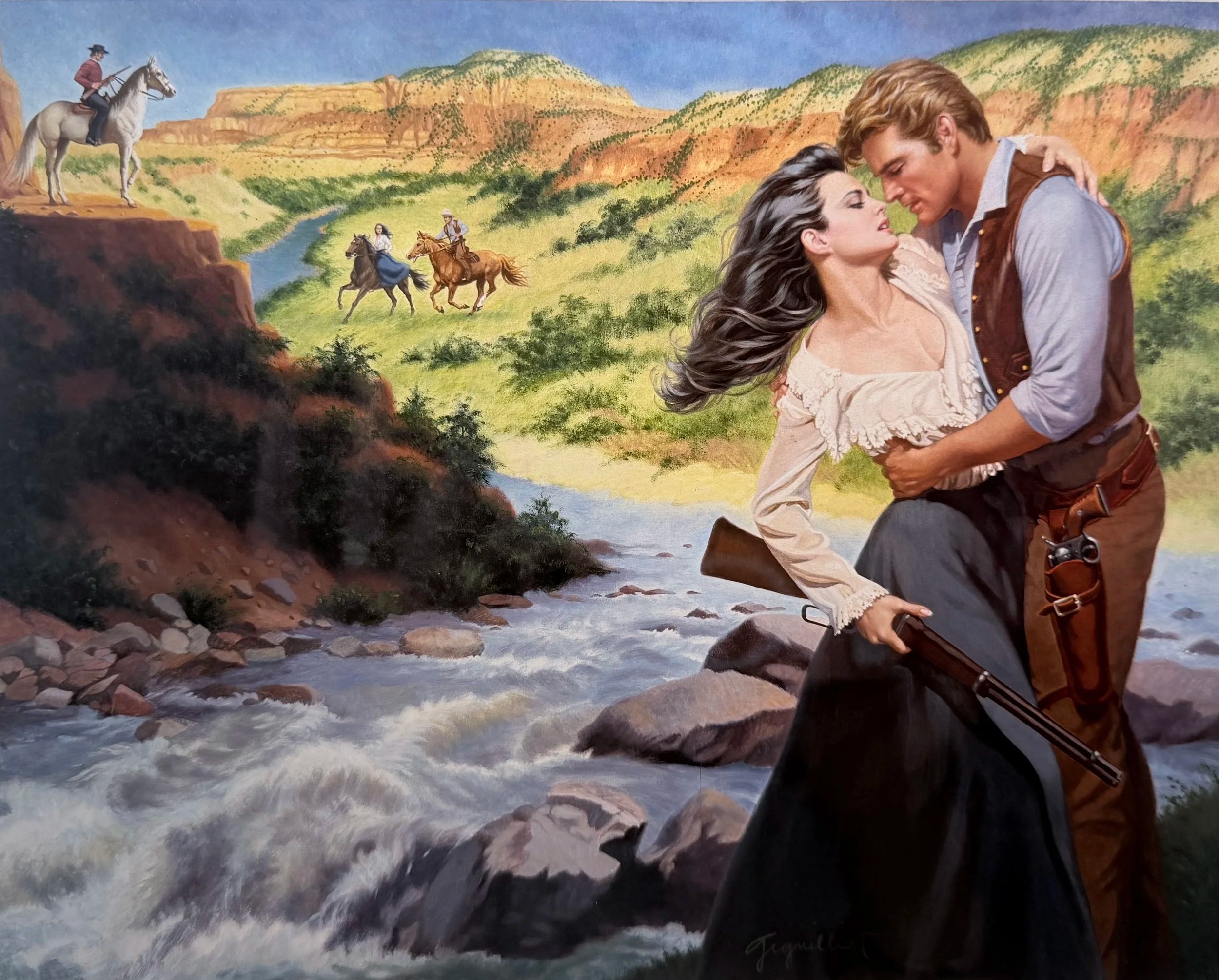
The painting tells more than one story at once. In the foreground, a couple is caught in an intimate embrace, seemingly oblivious to the danger and drama unfolding around them. His protective hold, her backward lean, and their nearly touching faces create a moment charged with desire and anticipation. Yet her hand rests on a rifle, a reminder that this is no passive heroine.
Look beyond the lovers. Two riders gallop across the valley, while a lone horseman watches from a rocky bluff above. Are they pursuing someone, escaping danger, or approaching an inevitable confrontation? Elaine leaves these questions unanswered, inviting us to imagine the story.
The details establish a vivid American Western setting: the rugged canyon walls, rushing river, horses, leather gun belt, and the woman's lace-trimmed blouse. The contrast between her delicate clothing and the rough landscape heightens the sense of romance and adventure.
Elaine's Artistry
Elaine masterfully combines an expansive Western landscape with an intensely personal moment. The composition operates on two scales: a sweeping panorama of movement and potential danger, and a close-up of two people suspended in a moment of romantic tension.
Her use of perspective draws the eye from the lovers in the foreground, across the turbulent river, and into the distant valley. The tiny horseback figures give the landscape depth and scale while introducing a second narrative that enriches the central scene.
Notice the interplay of color, light, and texture. The sunlit golds and greens of the canyon contrast with the dark clothing and hair of the heroine, while the white lace of her blouse echoes the foaming water below. The softness of skin and fabric is set against the hard edges of rock, leather, and steel.
Most striking is Elaine's ability to convey emotion through gesture and body language. The lovers' faces are close but their lips have not met. Their bodies suggest both surrender and strength. It is a quintessential Elaine Gignilliat moment: the instant before the kiss, when anticipation becomes as compelling as the embrace itself.