The Heirs to Love
Barbara Ferry Johnson
The Story
At the peak of fulfillment, beautiful Leah is mistress of a sprawling chateau outside Paris and wife to Baptiste Fontain, once her wealthy Creole master. And now, as Europe enters its most turbulent era, the children move to center stage.
The Heirs of Love are: Lisette, the blonde beauty who was driven to flirt with English nobility by her husband's notorious pursuits: Nicole, passionate and artistic, who enjoyed the company of Van Gogh and Cezanne, but found love in all the wrong places, and Jean, a brilliant entrepreneur who would risk the future of a dynasty for the sake of a powerful strange love.
Detail Worth Noticing
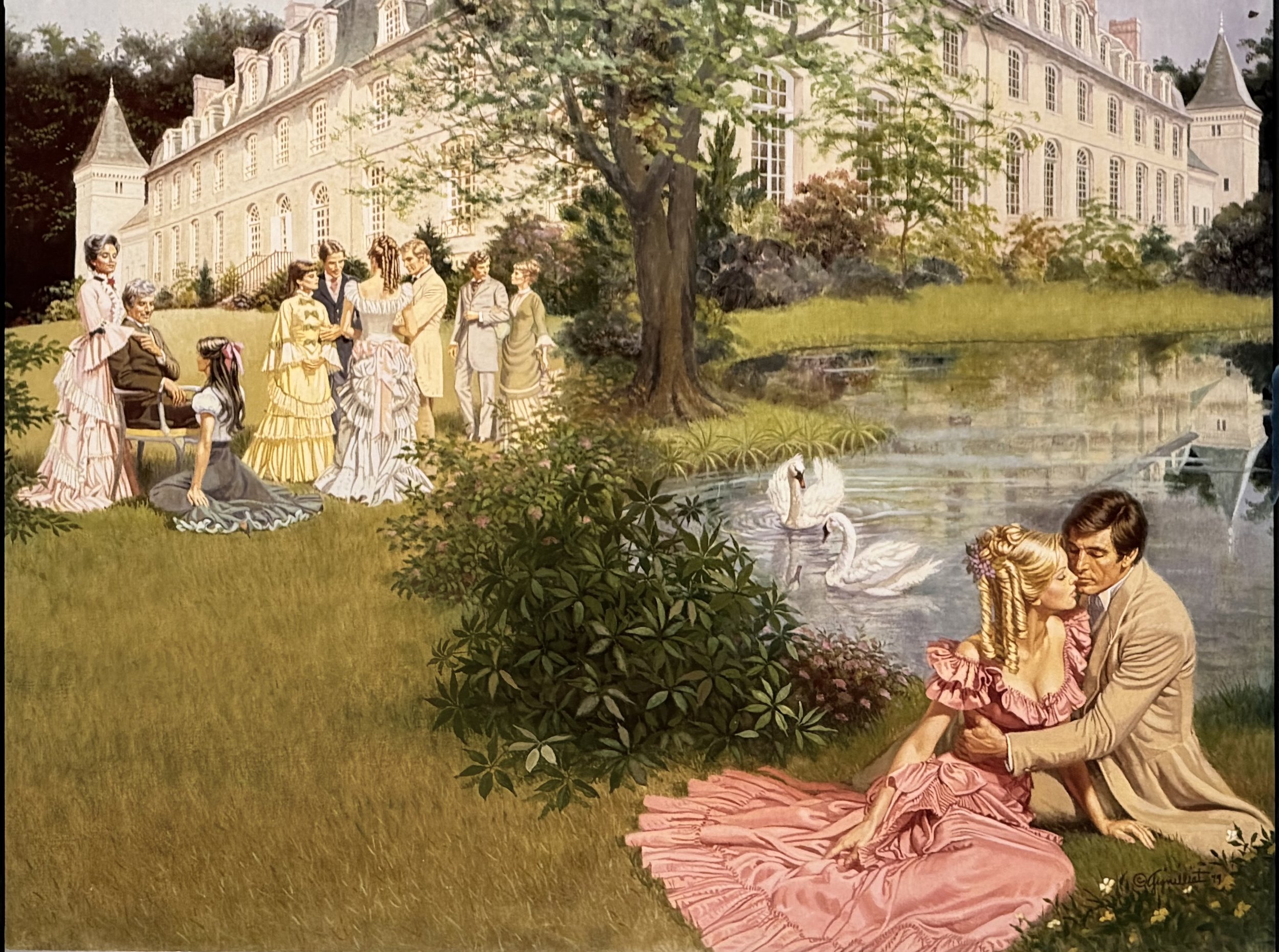
At first glance, this is an idyllic scene of privilege and elegance: a magnificent château, beautifully dressed guests gathered on the lawn, and two graceful swans gliding across a tranquil pond. But look more closely, and a second, more intimate story emerges.
In the foreground, partially concealed from the gathering, a couple shares a passionate moment. Her extravagant pink gown spills across the grass as he draws her close. Their proximity suggests an intimacy that contrasts with the formal social rituals unfolding just a short distance away.
Notice the gathering beneath the trees. The elaborate dresses, attentive gentlemen, and older seated figure suggest a world governed by social expectations, family relationships, and perhaps arranged alliances. Are the lovers stealing a private moment away from watchful eyes?
And then there are the swans, traditionally symbols of love and fidelity, floating serenely between the two scenes. Their presence adds a romantic counterpoint to the human drama.
Elaine's Artistry
Elaine creates a remarkable sense of place and narrative through the interplay of architecture, landscape, and human relationships. The grand château, with its repeating windows, mansard roof, and elegant towers, establishes a world of wealth and aristocratic tradition. Her meticulous rendering of period clothing, from the women's elaborate ruffles and bustles to the men's tailored coats, gives the scene historical richness.
The composition is particularly sophisticated. Rather than placing the lovers at the center, Elaine positions them in the lower right, balancing their intimate encounter against the distant gathering on the left. The sweeping lawn, towering tree, and reflective pond connect these two distinct worlds while maintaining their separation.
Notice, too, her use of color. The heroine's luminous pink gown immediately attracts the eye against the surrounding greens and earth tones. The soft creams and whites of the château and swans create visual harmony, while the darker foliage provides depth and frames the lovers.
Perhaps most compelling is Elaine's ability to tell two stories within a single painting: the public world of social convention and the private world of romantic desire. The contrast creates narrative tension without any overt action. We are left wondering who these lovers are, what obligations bind them, and what consequences might follow if their private moment is discovered.